

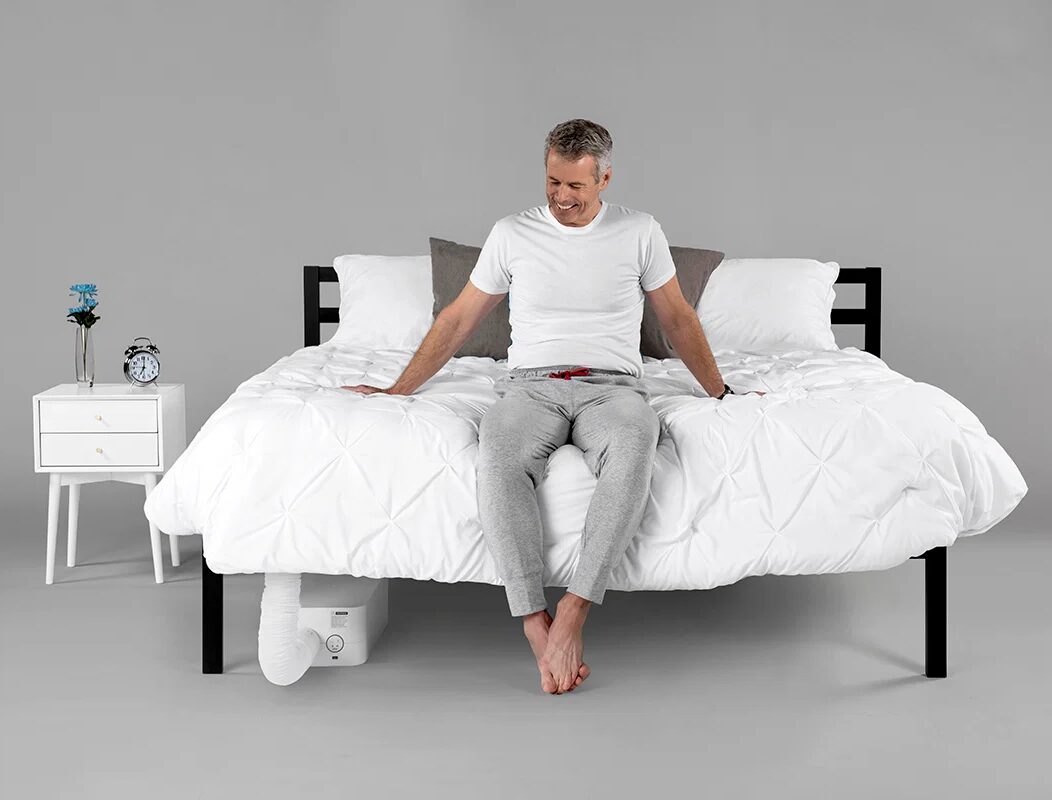
As you were looking for cool sleep solutions, you surely came across BedJet reviews. But does a $500+ bed climate system actually solve night sweats and temperature swings, or is it an overpriced fan? We broke down the BedJet 3’s features, real-world performance, pricing, and how it stacks up against water-based cooling systems so you can decide if it’s worth it for your bedroom.
What Is the BedJet 3?
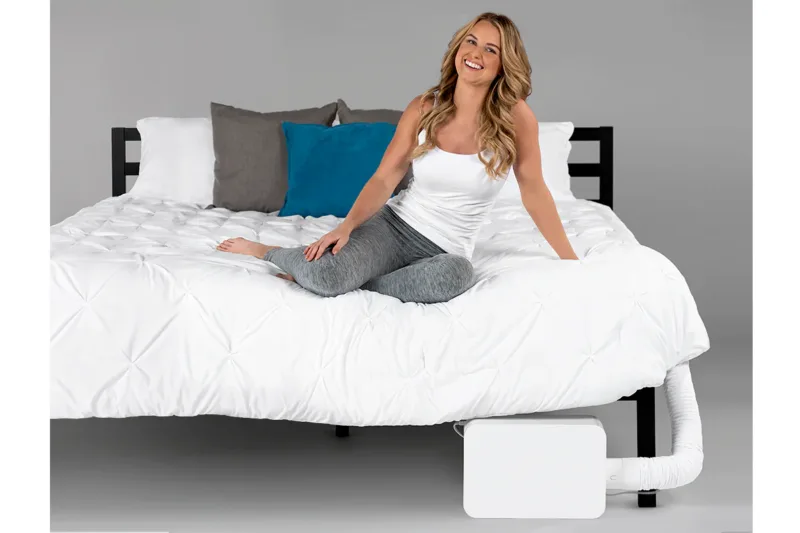
The BedJet 3 is a bed climate control system that pumps heated or cooled air through a hose into a fitted sheet attachment (BedJet calls it the “CloudSheet” or an air-permeable topper), rather than cooling a mattress directly with water, as competitors such as ChiliSleep do. The unit sits under or beside your bed frame and is controlled via a wireless remote or smartphone app.
Unlike box fans or standalone space heaters, the BedJet is designed specifically for in-bed use, with rapid temperature swings, a sleep-stage scheduling feature, and (on dual-zone models) independent control for each side of the bed.
Key Features
- Fast heating and cooling: The system is built to shift bed temperature quickly rather than gradually, which is one of its biggest differentiators from passive cooling pads.
- Dual-Zone option: Couples can run two independently controlled units so each side of the mattress has its own temperature setting – useful when one partner runs hot and the other runs cold.
- Biorhythm sleep programming: You can schedule different temperatures for different points in the night (warmer to fall asleep, cooler during deep sleep, warmer again near wake time). It’s a genuinely useful feature, though most owners report it takes some trial and error to dial in.
- Compact, under-bed design: The BedJet 3 is smaller than earlier generations and fits under bed frames with roughly 6 inches of clearance.
- App and remote control: A color-screen remote handles full control without needing your phone, and the companion app adds scheduling and remote access.
- Works with your existing bedding: No need to buy a special mattress — the hose and topper integrate with your current sheets and mattress type.
Does BedJet Actually Work?
The consistent theme across owner reviews and independent testing is that the BedJet 3 does what it claims: it moves noticeable warm or cool airflow through the bed and pulls moisture away from the sleeper, which matters most for people dealing with night sweats or a hot-sleeping partner. One reviewer’s tester in Texas found the cooling mode created a continuous breeze that kept her comfortable through hot summer nights, and reported her husband slept drier as a result.
Because the BedJet uses forced air and evaporation rather than circulating chilled water, it reacts faster than water-based systems but generally can’t drop temperatures as far below room temperature in a hot, humid room. Water-based systems like ChiliSleep can cool more aggressively in hot rooms, but they cost more, need reservoir maintenance, and involve tubing some sleepers find uncomfortable. If your main problem is a stuffy, stagnant bed rather than an overheated room, the BedJet’s airflow approach tends to be the more comfortable option to actually sleep with.
Noise is a common talking point in BedJet reviews: it’s not silent, but most owners describe it as a low, steady hum comparable to a bedroom fan on a low setting – noticeable at first, easy to tune out after a few nights.
BedJet 3 Pricing
At the time of this review, the BedJet systems start from $498 for the single unit and go up to $999 for the Dual Zone system for adjustable split-king beds. The Dual Zone system includes two BedJet 3 Minis, two wireless remotes with LCD screens, and a Dual Zone Cloud Sheet.
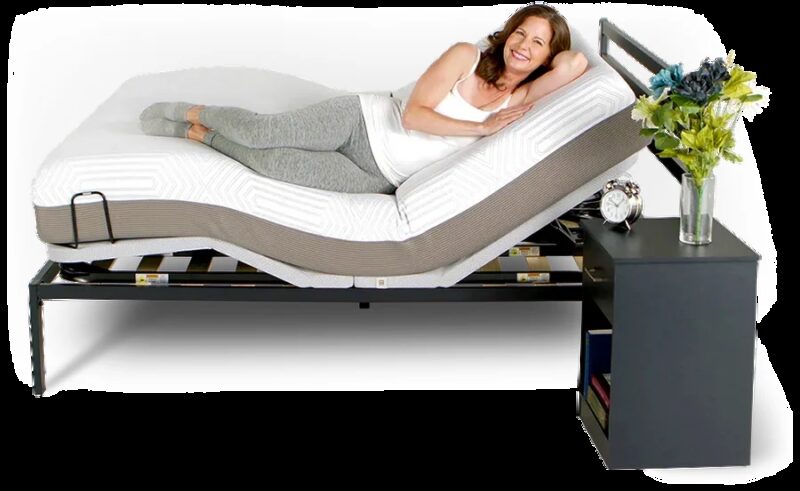
Those interested can buy an additional Cloud Sheet for $159 and PowerLayer Ultra-Thin Adjustable Bed Frames from $1199 to $2499 depending on size. Additional PowerLayer Accessories, like the PowerLayer Massage Motor Kit for $99, the PowerLayer Leg Kit for $89, or the PowerLayer Headboard Bracket Kit for $49.
The prices may vary depending on season and the brand’s promotional activities. BedJet runs frequent sales, so it’s worth checking current pricing before buying rather than assuming list price. The dual-zone setup is a meaningful jump in cost, so it’s really only worth it if you and a partner have genuinely different temperature preferences. A single flagship unit can be enough if you’re both comfortable at the same setting. Also, if you’re in the market for a new mattress, you may find one with excellent cooling features and also upgrade your comfort and support, not just the cool feeling.
Pros and Cons
- Genuinely effective at cooling and heating the bed, not just marketing hype
- Fast temperature changes compared to passive or water-based pads
- Dual-zone option solves the classic “one partner is hot, one is cold” problem
- Works with your existing mattress and sheets
- Compact enough to fit under most bed frames
- Sleep-stage scheduling for hands-free overnight adjustment
Cons:
- Can be expensive for some, especially in dual-zone configurations
- Requires a nearby outlet, which can mean a visible cord if your bedroom setup isn’t ideal
- Some assembly and hose placement adjustment needed for a clean setup
- Older (pre-BedJet 3) units reportedly aren’t serviced by the company if they develop errors
- Biorhythm programming takes some experimentation to get right
BedJet 3 vs. Water-Based Cooling Systems
The most common alternative people compare against BedJet is a water-circulating system like ChiliSleep’s OOLER or Cube. The core trade-off:
- BedJet reacts faster, doesn’t require a water reservoir, and includes heating as a strong feature (not just an afterthought) – but its cooling ceiling in very hot, humid rooms is lower than water-based systems.
- Water-based pads can push temperatures further below ambient room temperature and run whisper-quiet, but they cost more upfront, need periodic water refills and maintenance, and some sleepers dislike the feel of the internal tubing.
- If night sweats and general bed stuffiness are your main issue, BedJet’s airflow model tends to be the more practical, lower-maintenance pick. If you’re in a very hot climate and want maximum active cooling below room temperature, a water-based system may perform better.
Who Should Buy the BedJet 3?
The BedJet 3 makes the most sense if:
- You or a partner deal with night sweats, hot flashes, or general overheating in bed
- You and your partner have different temperature preferences and want independent zones
- You want a system that works with your current mattress rather than replacing it
- You’d rather have fast, on-demand temperature changes than a slow-cooling pad
It’s probably not worth it if you’re on a tight budget, don’t currently have a temperature problem in bed, or you’re specifically chasing maximum sub-ambient cooling in a very hot, humid climate – in that case, a water-based system may be the better fit despite the higher cost and maintenance.
FAQ
Is the BedJet 3 worth the price?
For people who regularly deal with night sweats or mismatched temperature preferences with a partner, most owners and reviewers consider it worth it. If you don’t already have a temperature problem at night, the cost is harder to justify.
How loud is the BedJet 3?
It produces a low, steady hum, similar to a fan on a low setting. It’s noticeable when you first turn it on but most users report tuning it out within a few nights.
Does the BedJet 3 work with any mattress?
Yes — it’s designed to work with your existing mattress and bedding via a hose and air-permeable topper or fitted sheet attachment, rather than requiring a special mattress.
What’s the difference between single-zone and dual-zone BedJet 3?
Single-zone controls temperature for the whole bed. Dual-zone uses two independently controlled units so each side of the bed can be set to a different temperature — useful for couples with different preferences, but at a considerable additional cost.
How much clearance does the BedJet 3 need under the bed?
Roughly 6 inches of clearance is generally enough to fit the unit under most bed frames.

Bottom Line
Across the BedJet reviews we looked at, the consensus is consistent: the BedJet 3 works as advertised, with strong airflow-based heating and cooling, useful scheduling features, and a design that fits into your existing bed setup. The main barrier is price, especially for the dual-zone configuration. If nightly temperature regulation is a real problem for you, it’s a well-reviewed, functional solution. Just shop around for current sale pricing before you buy.